
Gregg County Civil Docket Searches
Begin at the official Gregg County Odyssey portal under Civil, Family & Probate Case Records. You can search by case, party, or attorney there. Try the full cause number first. If only a party name comes back, weigh it carefully. A shared name alone proves nothing until the court, case type, filing date, and other public details line up.
A district civil or family case belongs to the Gregg County District Clerk. County Court, probate, and certain county-law records may sit with the County Clerk instead. Small claims, debt claims, and evictions go to the right JP clerk. For routing help, read the court name. It is printed on any citation, petition, notice, or order from the case.
- Select the Civil, Family & Probate module in Odyssey.
- Search by cause number, party, or attorney.
- Confirm the court and civil case type.
- Read the filing and setting history in date order.
- Ask the responsible clerk for a missing judgment or certified copy.
Gregg Civil Filing Through eFileTexas
Most civil filings in Gregg County district courts go through eFileTexas, unless the matter qualifies as an emergency or the filer is self-represented in a recognized category. The county's instructions set firm formatting rules. Documents must be searchable PDFs. Later filings need a cause number, exhibits belong inside the pleading, and proposed orders travel separately. If the case is already open, do not start a new action; add to the existing docket instead. Remember that the system just delivers papers to the clerk. It is not a public archive of court records.
Rejection happens. So do empty search results. When either occurs, confirm the county and the cause number, then look at the filing envelope through your approved provider. Still stuck? Contact the District Clerk directly. One caution: confidential information should never ride the normal e-file path. Sealing and clerk notice require the separate procedure the county instructions spell out.
Note: A hearing coming up fast may also need a courtesy copy if it lands inside the clerk's stated processing window.
Civil Dockets: What They Show
Think of a Gregg County civil docket as the case's event list. A petition leaves a line. So do an answer, a service return, a motion, a setting, an order, a judgment, or a post-judgment paper when they enter the file. The docket usually lacks the full exhibit. It also lacks an image of every document behind those entries. It proves an event was recorded, nothing more. For the actual paper, turn to the case file the clerk maintains.
| Cause number | The court identifier used for the most exact search. |
|---|---|
| Parties | People or entities formally named in the proceeding. |
| Filings | Petitions, answers, service papers, motions, and other recorded items. |
| Settings | Hearings, trials, mediation, or case-management dates. |
| Outcome | Signed judgment, order, dismissal, or later post-judgment activity. |
Gregg Justice Court Civil Records
The Justice Courts give Gregg County a second civil route. JP pages list small claims and debt claims capped at $20,000, plus evictions. Their form sets are extensive. Petitions, answers, default-hearing requests, certificates of last known address, abstracts of judgment, writs of execution, eviction papers, repair-and-remedy filings, and appeal forms. All of it sits with the precinct court rather than with the District Clerk automatically.
The justice-court rules describe a permanent docket. It holds the suit title, the date and nature of first process, appearances, every filed paper, adjournments, the trial date, whether a judge or jury heard it, the verdict, the signed judgment, new-trial requests, and anything later. That structure is why a JP docket can settle procedural questions. It works even without party-level sample PDFs online. One practical tip applies to visiting. Call the precinct first, especially JP3, since county pages give conflicting location details.
What Cases Fill the Civil Docket
Gregg County civil dockets span several jurisdictions. District courts hear major civil and family matters. The two County Courts at Law have civil authority defined by Texas Government Code §25.0942. The constitutional County Court is associated with civil, probate, and mental-health functions in the official court directory. Justice Courts handle lower-dollar claims and evictions.
- Major civil disputes and property or contract actions in District Court
- Family cases assigned to the district level
- County-law civil matters within statutory jurisdiction
- Probate and related constitutional County Court work
- Small claims, debt claims, evictions, and repair-and-remedy cases in Justice Court
Municipal courts in Gregg County rarely handle ordinary civil claims. Picking the civil module in a docket search does not settle the venue question. If a probate, family, JP, or county-law case comes back, check the docket with the office that actually holds that court record before you ask for a file.
Gregg Clerk Choice by Case
Seeing "Gregg County" on a docket entry means little. It does not tell you which clerk keeps the record. The District Clerk holds district civil and family filings. The County Clerk covers county-level work, including probate and certain civil records assigned to that office. Every justice of the peace keeps a separate civil docket. The County Courts at Law take extra care. Confirm where the individual case sits before you request the filing.
| Case type | Likely venue | First records contact |
|---|---|---|
| Major civil or family | District Court | District Clerk |
| Probate or county matter | County Court | County Clerk |
| County-law civil | County Court at Law | Confirm clerk allocation |
| Small claim, debt, eviction | JP precinct | Individual JP clerk |
When Odyssey does not show a document, the clerks can still help by phone or at the counter. District Clerk records help is available at the courthouse, by phone at 903-237-2663, and through confirmed mail procedures. The County Clerk's current number is 903-236-8430.
Hearings on the Civil Docket
A Gregg County civil docket lists motion hearings, pretrial dates, mediation, trials, and dismissal settings. Other case-management events appear there too. The 307th District Court's local rules cover check-in, attendance, continuances, trial settings, discovery, settlement, and alternative dispute resolution. Remember what a setting means. It shows what the court calendared. It does not show that a motion was granted or a judgment entered.
Always pull the newest docket entry before acting. Confirm any changed date with the coordinator or clerk. A pass, reset, or continuance can slide a case to a later calendar. The Gregg County court schedule walks through the local calendar network in more depth. If you have a lawyer, check with counsel too, since a public index can lag behind a signed scheduling order on your Gregg County case lookup.
Gregg Civil Copies and Fees
The docket tells you a filing exists. The clerk is who actually supplies the copy. Under the Gregg County District Clerk schedule effective January 1, 2026, a records search costs $5, certification $5, and counter copies $1 per page. Electronic-file copies run $1 for the first ten pages. After that they cost ten cents per page. County e-file instructions bar emailing certified copies.
Before paying for certification, ask whether a plain copy would serve. Give the clerk the cause number, court, document title, and date. Calling ahead about mail orders is smart, since accepted payment, return-envelope terms, and totals change. A statewide re:SearchTX view may give role-based electronic access. It cannot replace a Gregg County clerk's certification.
Who Can See Civil Dockets
Plenty of Gregg County civil docket entries are public. Not every file or field is, though. Texas Rule of Judicial Administration 12 supplies the main judicial-record request frame, Texas Rule of Civil Procedure 76a governs civil sealing, and Rule 21c requires sensitive-data protection. Family, juvenile, and protective-order records may carry extra limits, and a portal entry can stay visible even when a protected attachment stays closed.
Key rules:
Texas Rule of Judicial Administration 12 governs access to judicial records.
Civil Rules 76a and 21c address sealing and sensitive-data redaction.
Family Code Chapter 58 protects juvenile records.
A Rule 12 request should identify the record being maintained. The rule never forces a court to create a new one. When a matter is sealed, ask whether a public redacted copy exists. Also ask what court process governs access. A generic Texas Public Information Act request cannot get around the judicial-record rules.
307th Gregg Family Civil Route
Family matters use the district-court side of Gregg County's civil system. The 307th District Court page provides family resources and dismissal-setting information, while the District Clerk maintains district family filings. A public Odyssey search may identify the case without exposing each filing because family and juvenile records can carry added access limits.
The official 307th District Court source shows its family and setting resources.
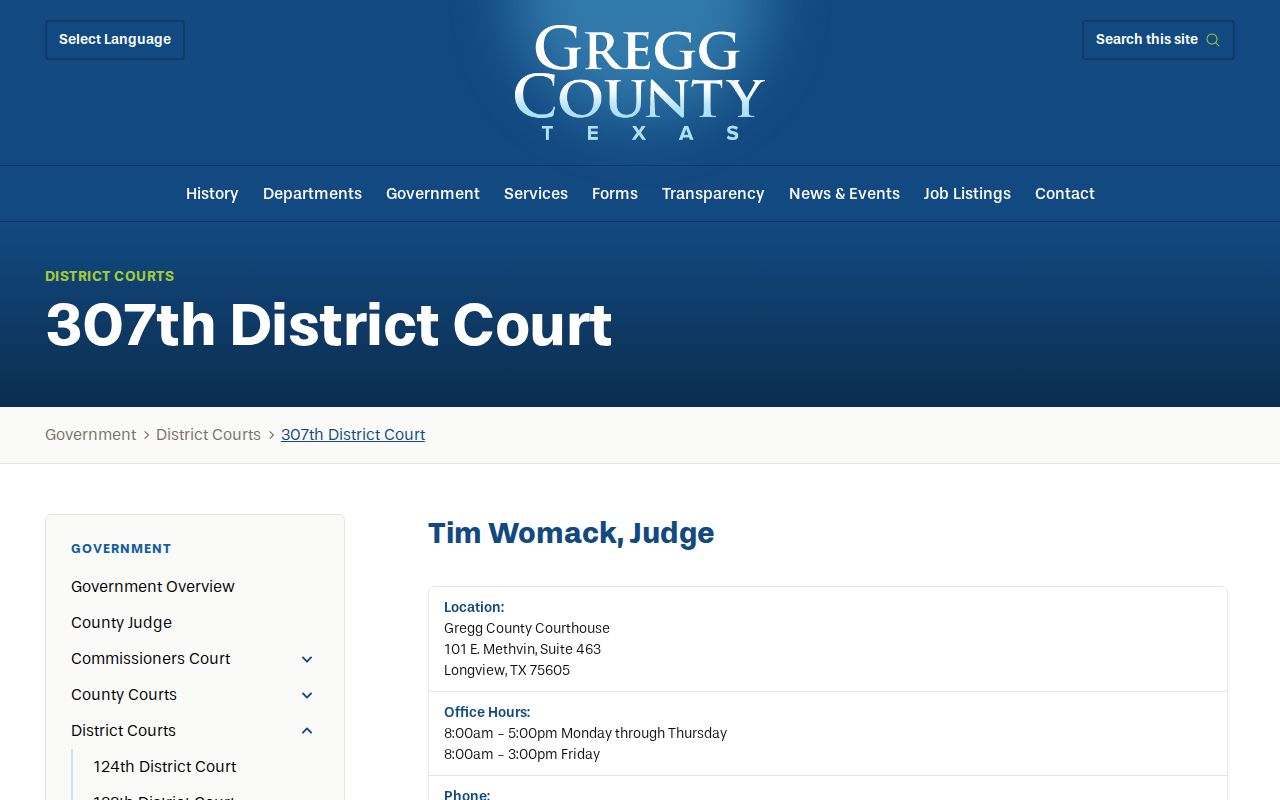
This is why a family docket belongs with the district court and clerk. An ordinary JP civil track is the wrong door for these Gregg County filings.