
Gregg County Court Docket Searches
Start your Gregg County court docket search at the official Gregg County Courts Records Inquiry. The Odyssey landing screen splits into modules: Civil, Family and Probate, Criminal, Calendar, Jail, and Jail Bond. Pick the one that fits your paper. A jail booking and a criminal setting live in different places. A city citation will not sit beside a district felony.
Have your details ready before you type. A party or defendant name, the cause number, the named court, and a rough filing date all help. Spelling and venue matter too. When several results come back, weigh the case type, dates, and court before trusting any single match. The match should fit on all three points.
- Read the citation, notice, or pleading to identify the court.
- Choose the matching Odyssey module or official court calendar.
- Search by name, cause number, attorney, or citation when offered.
- Review entries and settings, then note the source and update date.
- Ask the proper clerk for an omitted filing or certified copy.
Gregg Odyssey Search Modules
Odyssey is not one giant Gregg County court docket. It works like a hallway of separate search doors. Civil, family, and probate matters share one module, criminal cases sit in another, the Calendar module tracks settings, and Jail plus Jail Bond cover custody. Choosing the right door first cuts a name search down fast.
| Module | Search clues | Purpose |
|---|---|---|
| Civil/Family/Probate | Case, party, attorney, date range | Civil and related county or district matters |
| Criminal | Case, defendant, attorney, citation | Criminal docket events and settings |
| Calendar | Court, date, judge, party, attorney | Scheduled hearings and court lists |
| Jail/Jail Bond | Custody or bond details | Separate detention information |
The portal can change its visible fields. Treat the official interface as the current word. A no-match result does not prove a record is missing; the venue may be wrong, indexing may lag, or access may be limited.
Court Dockets: What They Show
Think of a docket as the case event index. The clerk records the cause, court, parties, filed items, settings, and actions there. It may show that a motion was filed or an order entered. It will not let you see the document itself. A calendar PDF is narrower still. It lists only matters set for a given day or docket call.
| Case number | A local key such as YYYY-NNNN; confirm the court and case type. |
|---|---|
| Parties | Names or roles used to identify the case, subject to access limits. |
| Entries | Dated petitions, answers, motions, notices, orders, and judgments. |
| Settings | Hearing date, time, court, judge, and setting label when published. |
| Disposition | The recorded outcome, checked against the filed order. |
Gregg County entries use stage labels: arraignment, appearance, pretrial, status, carryover, trial, dismissal, and bond forfeiture. These mark a setting, not an outcome. A status or trial listing is never itself a conviction, judgment, or dismissal.
Gregg Calendar PDFs Have Limits
The county court pages publish handy setting lists. The County Court at Law 1 page links arraignment and criminal calendars, and the district court pages post trial and other settings. Those PDFs tell you who is set, where, and for what kind of call. They still do not replace the full court file.
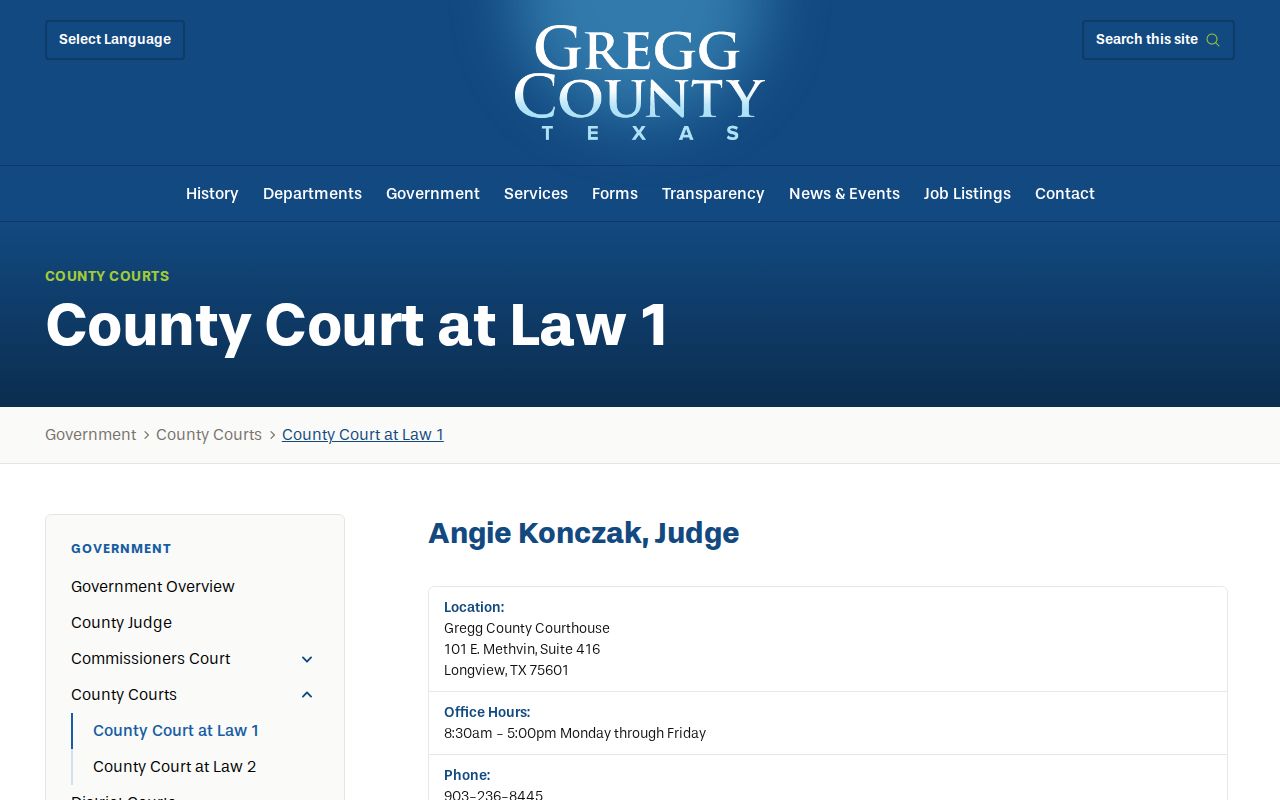
Check the title and date on any list you download. An old PDF can linger after a setting moves. For an appearance or deadline, confirm the latest date with the court or clerk. The current docket and the filed order carry more weight than an archived list. Do not rely on the list alone.
Gregg County Courts and Their Dockets
Gregg County has several docket keepers. The District Clerk maintains district civil, family, juvenile, and felony records, while the County Clerk keeps the county and probate records assigned to that office. Justice and municipal clerks each hold their own lower-court dockets.
| Court | Main work | Record route |
|---|---|---|
| 124th, 188th, 307th District Courts | Felony, major civil, family, juvenile | Odyssey and District Clerk |
| County Courts at Law | Specified misdemeanor and civil matters | Odyssey, calendars, responsible clerk |
| Constitutional County Court | Probate and mental-health functions | County Clerk |
| Justice Courts 1 through 4 | Class C, small and debt claims, evictions | Precinct clerk |
| Municipal Courts | City ordinance and fine-only Class C cases | Issuing city court |
Federal matters sit outside this chain. PACER and the Eastern District of Texas CM/ECF hold federal dockets. State appeals from Gregg County generally land at the Sixth Court of Appeals at Texarkana.
Gregg Has Several Docket Keepers
Clerk titles carry real meaning here. Trey Hattaway, the District Clerk, is the route for district files, and Michelle Gilley, the County Clerk, handles the county records allocated to her office. Four JP clerks and each city clerk keep separate dockets of their own. That split explains many failed court record searches.
- District Clerk
- District civil, family, juvenile, felony, and related filings.
- County Clerk
- County court, probate, and specified civil or misdemeanor records.
- Justice Court clerk
- Precinct Class C, eviction, small-claims, debt-claim, and magistrate records.
- Municipal clerk
- City ordinance and Class C cases filed in that court.
Begin with the court named on your document. If you hold only a name, search Odyssey first, then test the correct city or justice route. Give the clerk a cause number, court, document name, and date range whenever you can.
Court Dates and Settings in Gregg County
Two date paths exist: the Odyssey Calendar module and the individual court pages. The 124th and 188th District Courts post arraignment, carryover, status, and trial links. The 307th District Court offers family rules and dismissal resources. County Courts at Law publish separate criminal calendars.
Read the court title before the date. Check the setting type, time, courtroom, and cause number. A reset, pass, continuance, or cancellation can move a matter after a PDF posts. The full Gregg County court schedule explains how to compare online, phone, counter, and statewide access. Each route has its place.
Confirm the setting. A calendar entry shows a planned event, not the final result, and an archived PDF may not reflect the active date.
Gregg E-Filing Shapes the Index
The District Clerk's e-file business process shows how civil documents become court records. Gregg County runs eFileTexas with Tyler Technologies and an approved service provider. Filings should be word-searchable PDFs on standard pages, usually one filing item per PDF. Exhibits travel with the pleading, but a proposed order files separately. The guide calls for 300 DPI scans.
Confidential data should never go through the normal route. Use the sealing process and notify the clerk instead. Processing can take 24 hours, so a near-term hearing may need a courtesy copy. That delay often explains why a recent filing is missing from a Gregg County docket. A pending filing should carry the cause number.
When eFileTexas reports "No Cases Found," the clerk's instructions give a fix. Check both the cause number and the county. A filing envelope and a public docket entry serve different jobs too. Submission alone does not mean the clerk has accepted, indexed, and made every document viewable. For urgent settings, the court's own rules and coordinator instructions still govern.
Docket Access Under Texas Law
Getting judicial records is not quite the same as asking an executive agency for papers. Texas Rule of Judicial Administration 12 sets the judicial-record route. Statutes and court rules protect sealed, confidential, and restricted material on top of that. The custodian can tell you whether a file is public. The custodian can also explain how to request it.
Key rules:
Texas Rule of Judicial Administration 12 gives a process for requesting judicial records from the proper custodian.
Texas Government Code Chapter 552 is the Texas Public Information Act, while judicial records follow the court framework where it applies.
Texas court rules address filing, access, sealing, and sensitive material.
Some things stay off a public Gregg County court docket. Juvenile matters, sealed items, expunction or nondisclosure records, and protected family details may not appear publicly, and redaction can strip sensitive fields from a record that is otherwise open.
When Gregg Odyssey Finds Nothing
A blank result on Gregg Odyssey can mean several things. The case might sit in a city court or a JP precinct, a new filing may still be processing, or the name may simply be indexed differently. It could also be sealed, confidential, or available only through a clerk request.
- Check the issuing agency and court on the notice.
- Try the cause number and a narrow date range.
- Review the court's current calendar page.
- Contact the clerk with court and document details.
- Ask whether access, scanning, or certification limits apply.
Do not lean on the Jail module in place of the criminal docket. Custody data and case history answer different questions. A payment vendor may recognize a ticket yet still leave out the complete municipal docket.
Make clerk questions precise. Ask whether that office holds a named cause, and whether a specific motion or order has been indexed. Ask also whether copies can be made. Give the court and a date range. With only a citation in hand, use the court printed on it. A Longview municipal ticket, a Gregg County JP citation, and a County Court at Law misdemeanor can travel three separate paths. All of them sit inside Gregg County.
How the Clerk Keeps Docket Records
The clerk records filings and court activity, indexes each case, and provides available copies. When you make a request, state the court, cause number, document title, and filing date. Say whether a plain or certified copy is needed. Only the clerk can certify a copy of a court record. An online printout is not a certified one.
Gregg County District Clerk
101 E. Methvin Street, Suite 334
Longview, TX 75601
Mail: P.O. Box 711, Longview, TX 75606
903-237-2663
Monday to Friday, 8 a.m. to noon and 1 to 5 p.m.
Gregg County Clerk
101 E. Methvin Street, Suite 200
Longview, TX 75601
903-236-8430
Monday to Friday, 8 a.m. to noon and 1 to 5 p.m.
Gregg Copy Types and Fees
The District Clerk fee schedule effective January 1, 2026 treats searching, copying, and certification as separate services. Because service, publication, and issuance costs vary, check the official schedule before sending any funds.
| Service | Listed amount | Confirm |
|---|---|---|
| Records search | $5 | Scope and identifiers |
| Certification | $5 | Document and format |
| Counter copy | $1 per page | Page count |
| E-file copies | $1 first ten pages, then 10 cents per page | Delivery and eligibility |
| Listed issuance | $8 | Service and added charges |
A docket entry, a plain copy, and a certified copy each serve a distinct need, so ask which product fits the request. Printing an Odyssey screen does not create a certified record.
Gregg Courthouse Suite Directory
Gregg County's county history page sets today's record work inside the 1932 Art Deco courthouse. The building rose during the East Texas oil boom. It is still the county hub. Still, the street address alone will not get you to the right desk. Offices occupy separate suites, and several lower courts sit elsewhere.
Inside the courthouse, Suite 200 is the County Clerk. Suite 334 is the District Clerk. Suite 416 is CCL1, Suite 447 the 124th District Court, Suite 512 JP1, and Suite 109 Collections. Both clerks close for lunch from noon to 1 p.m. A quick call before a special trip helps, especially for a JP or city case.
JP2 sits at the Greggton Community Building in Longview. JP4 is on South Eastman Road. Gregg County pages conflict on where JP3 meets the public. The dedicated court page lists North Kilgore Street. Other routing material points elsewhere. That conflict is a reason to call the precinct before travel. It is not a reason to send the case to the main courthouse by default.
City-by-City Court Dockets in Gregg County
Each profiled city in Gregg County runs its own municipal route for ordinance and fine-only Class C matters. Ranked by 2020 Census population, they are Longview, Kilgore, White Oak, Gladewater, and Lakeport. The issuing city is often the right starting point. A nearby county portal does not change that.
Longview Court Records
81,638 people in 2020. Payment search, court contact, and Virtual Docket routes.
Kilgore Court Records
13,376 people in 2020. Sessions and clerk payments use two city locations.
White Oak Court Records
6,225 people in 2020. The city court page and phone are the documented fallback.
Gladewater Court Records
6,134 people in 2020. Payment, fine-list, and dated warrant-list routes.
Lakeport Court Records
987 people in the 2023 OCA report. The traffic workflow starts with the clerk.
Each city page keeps its own focus for Gregg County court dockets. Felonies, major civil matters, probate, and justice court cases still run through the courts and clerks mapped above.
Map and Directions to the Gregg County Courthouse
District Clerk and County Clerk records, along with the 124th, 188th, and 307th District Courts and both County Courts at Law, are kept at the Gregg County Courthouse, 101 East Methvin Street, in downtown Longview. The seven-story Art Deco building assigns each office its own suite: District Clerk in Suite 334, County Clerk in Suite 200, JP1 on the fifth floor in Suite 512, and the Collections Office in Suite 109. Confirming the suite before a visit saves a trip between floors.
Gregg County Courthouse
101 East Methvin Street
Longview, TX 75601
903-758-6181
Monday to Friday, 8 a.m. to noon and 1 to 5 p.m.
The District Clerk and County Clerk close for lunch from noon to 1 p.m., matching the courthouse-wide schedule. Gregg County's justice-court and municipal dockets are handled elsewhere, so a felony, civil, family, or probate file is the reason to come to this building.